Email & SMSOriginal dataBrand stacks
Klaviyo runs email for 79% of indexed DTC brands. Four samples, one answer.
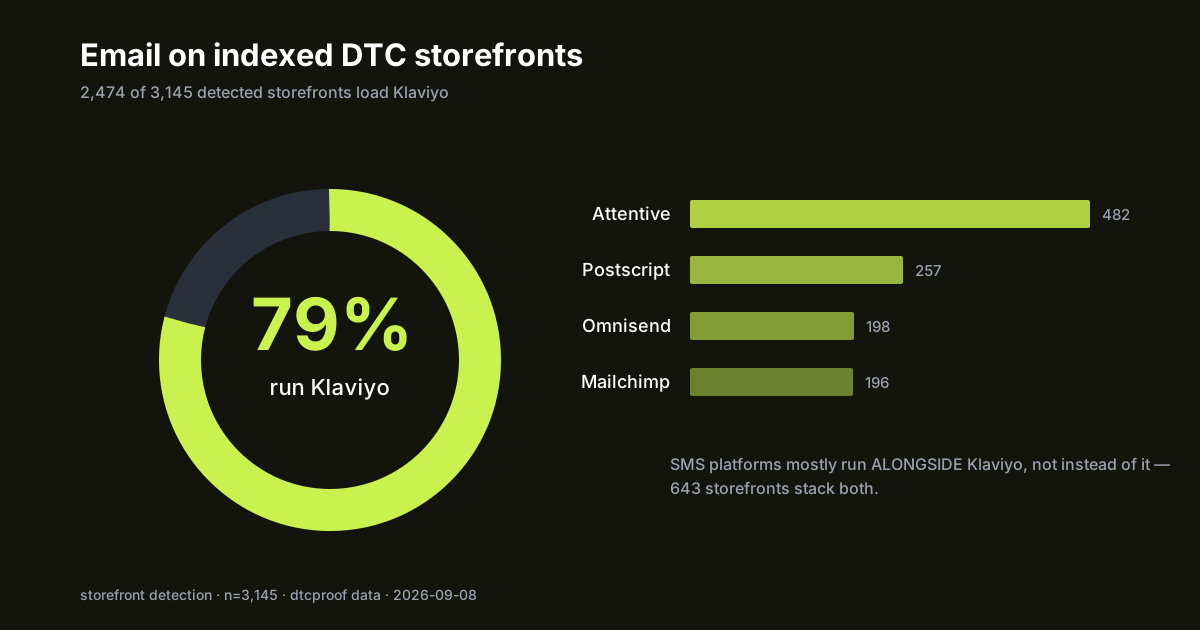
Updated 2026-08-20: fourth measurement. 76% across 59 hand-picked brands, 82% at 1,710 detected storefronts, 81% at 2,916, and 79% at 3,145 — the last expansion reaching deliberately BELOW directory-indexed DTC, into a consumer-sentiment ranking. Six points of spread across four differently-built samples, and the two-point dip is the most informative number in the set.
Of the 3,145 indexed DTC storefronts we scan, 2,475 load Klaviyo. Seventy-nine percent. When we first measured 76% on a curated cohort, the obvious objection was selection bias — famous brands cluster on famous tools. Three expansions later the share has moved by two points, and we now know exactly what moves it: not time, but which population you sample.
The layer in numbers
| Platform | Detected on | Share of 3,145 | Top-300 brands |
|---|---|---|---|
| Klaviyo | 2,475 | 79% | 246 |
| Attentive | 483 | 15% | 72 |
| Postscript | 257 | 8% | 37 |
| Mailchimp | 199 | 6% | 13 |
| Omnisend | 198 | 6% | 14 |
Where the challengers actually live
The bigger sample keeps locating them precisely. Mailchimp survives in the tail — 199 stores, but just 13 of the top-300: legacy installs and side projects, not chosen infrastructure. It edged back ahead of Omnisend (198) this scan, and both gained in the same place: the new cohort. Their value pitch is real below the indexed tier and modest at every tier above. What we still don’t find, anywhere, is a cluster around a “Klaviyo killer” — nobody is taking the premium tier.
The genuinely unmeasured competitor is enterprise ESPs (Braze, Iterable) loading server-side, invisible to storefront scans — some slice of our 670 Klaviyo-less brands surely runs them. Absence of evidence, as always in our method, is not evidence of absence.
Where the two points went
The fourth sample was built differently on purpose. The first three came from DTC directories — populations that already select for brands with traction. This one came from a consumer-sentiment ranking of 350 pet brands, which selects for being loved, not for being an indexed DTC operator. It reaches a population beneath ours, and the contrast is stark:
| consumer-ranked cohort | rest of the index | |
|---|---|---|
| Klaviyo | 53% | 81% |
| Shopify | 76% | 93% |
| WooCommerce | 14% | 2% |
| Judge.me | 31% | 20% |
| Gorgias | 8% | 26% |
| median tools per store | 3 | 6 |
Klaviyo’s share is 28 points lower there. That is the entire two-point move in the headline number, and it says something the aggregate hides: Klaviyo’s dominance is a property of the indexed tier, not of ecommerce. Below that tier, half the stores run something else, a seventh run WooCommerce, and the median store runs three tools rather than six.
So the honest version of the moat claim is narrower than “81% of DTC.” It’s: among brands big enough to appear in a DTC directory, Klaviyo is the default and nothing is challenging it. Reach below that line and the layer is genuinely contested.
The stacking pattern, quantified
The SMS layer keeps telling the strongest quiet story in retention. Attentive (467 storefronts) and Postscript (253) run overwhelmingly alongside Klaviyo — dedicated SMS bought on top of the email default, despite Klaviyo selling SMS natively. 633 storefronts run the combination outright, and at the top of the index the pattern intensifies: 96 of the top-300 run Klaviyo plus a specialist SMS line (70 Attentive, 37 Postscript). Hundreds of sophisticated retention teams keep concluding that specialist SMS beats the bundle — a verdict about deliverability, compliance workflows, and agency ecosystems that no feature table would show you.
Budget accordingly: if the plan is “serious retention brand,” price Klaviyo-plus-a-specialist from day one. The stack you’ll converge on is visible in 633 storefronts’ code.
What this means if you’re choosing
Adoption isn’t proof of fit — Klaviyo’s pricing scales hard with list size, which is exactly why Klaviyo vs Omnisend stays the category’s most-searched comparison. Under a few thousand contacts, several platforms serve you well and cheaper. But the index data now describes the endgame with replicated weight: 81% of brands that got big enough to appear in a DTC directory ended up on Klaviyo, and the top tier added a specialist SMS line. Choose against that gravity only with a reason you can name.
Tracked pricing for the whole layer, verification dates on every number: email & SMS category.
Method note
Storefront signature detection, n=3,145 detected of 3,797 indexed brands, scanned August 2026, re-run weekly. Homepage + one product page per store. The index draws on three independent sources: our curated seed list, two DTC directories, and — added 2026-08-20 — a consumer-sentiment ranking that deliberately reaches below directory-indexed DTC. Cite as “DTC Proof storefront detection, 2026-08-20, n=3,145.” Full method and limits: methodology.
FAQ
Is 79% really comparable to the earlier 76%, 82% and 81%? Directionally yes, and the sequence is the point: four samples with different construction (59 curated → 1,710 directory-indexed → 2,916 across two directories → 3,145 including a consumer-sentiment cohort) landing within six points of each other is stronger evidence than any single measurement. The fourth is the most useful precisely because it moved: it located the edge of Klaviyo’s dominance rather than confirming its centre.
Why is Attentive ahead of Postscript here? Attentive sells top-down into larger brands (70 of the top-300 vs Postscript’s 37); Postscript’s self-serve strength shows proportionally more in the tail.
Will you track Braze/Iterable? When we add rendered and server-side detection approaches — storefront signatures can’t see them, and we won’t pretend otherwise.