ReviewsData analysisBuying guides
The review-app paradox: 43,000 five-star ratings, 20% of the index
Updated 2026-08-09 with the expanded index: 3,145 detected storefronts, up from 1,710, up from the original 59. Each expansion deepened the paradox — and the latest one proved its mechanism.
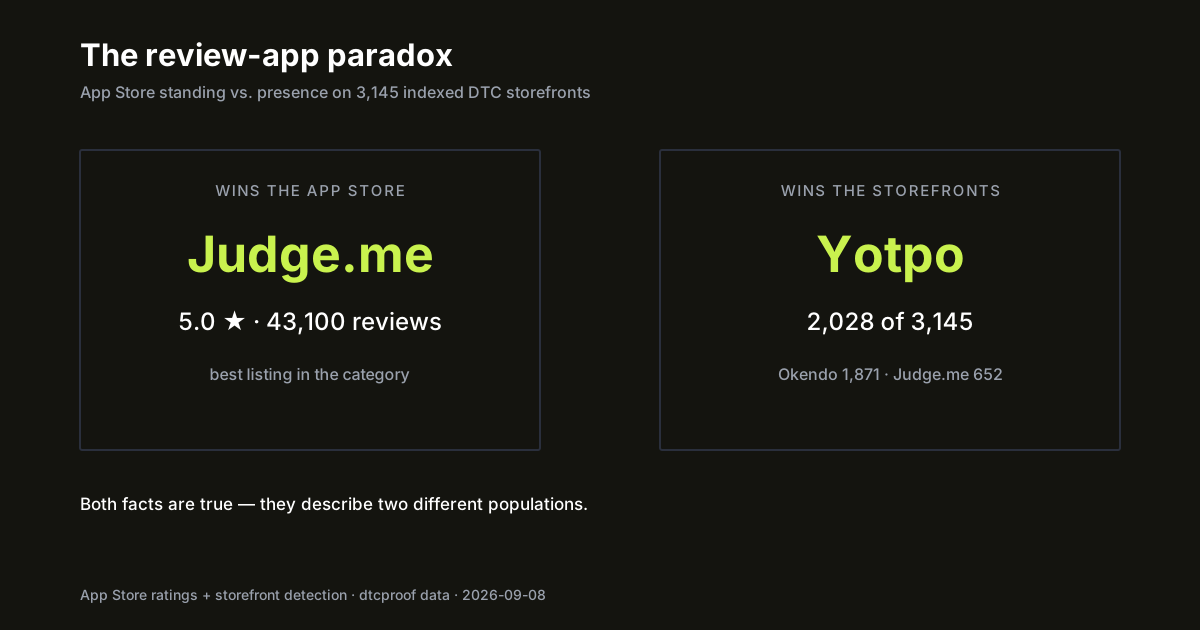
If you rank Shopify review apps by App Store rating, Judge.me wins — 5.0 ★ across 43,100 reviews, the strongest listing in the category and one of the strongest anywhere. If you rank them by presence on the 3,145 indexed DTC storefronts we scan, the order inverts: Yotpo on 2,027 (66%), Okendo on 1,795 (61%), Judge.me on 573 (20%).
Both datasets are real. Neither is wrong. Understanding why they disagree is the most useful buying signal this category offers.
The numbers side by side
| App | App Store rating | Reviews | Indexed storefronts (of 3,145) | Top-300 brands | Price from |
|---|---|---|---|---|---|
| Yotpo | 4.8 ★ | 4,392 | 2,027 | 209 | platform from $89/mo |
| Okendo | 4.9 ★ | 1,314 | 1,795 | 177 | quote (order-tiered) |
| Judge.me | 5.0 ★ | 43,100 | 573 | 29 | $0 (max $15/mo) |
| Junip | 4.8 ★ | 1,080 | 285 | 29 | free tier + paid |
| Stamped | 4.7 ★ | 3,406 | 168 | 12 | from $199, order-tiered |
| Loox | 4.9 ★ | 8,892 | 117 | 7 | ≈$50–$300 |
Detection method and limits: methodology. “Top-300” = the 300 highest-ranked brands in our Tranco×CrUX index.
Two markets — and this time we watched the boundary move
At 59 brands we hypothesized segmentation: Judge.me wins small merchants, Yotpo/Okendo win the establishment. At 1,710 the boundary sat below our index. The latest expansion added 1,394 brands from a second directory’s longer tail — and Judge.me’s share rose from 15% to 20% while its top-300 count held at 29. That’s the segmentation gradient made visible inside our own data: reach deeper into the tail, find more Judge.me; look at the establishment, find none added. Its 43,000 five-star reviewers live overwhelmingly in the population beneath directory-indexed DTC — the vast universe of small Shopify stores that directories never list — and the gradient now shows exactly where that population begins.
So the paradox resolves cleanly: App Store ratings measure the whole Shopify ocean; our index measures the brands with enough traction to be tracked. Judge.me is the ocean’s favorite. Yotpo and Okendo are the index’s infrastructure — often installed side by side (many stores run components of both suites, which is why their shares sum past 100%).
What merchants actually say (unchanged, and still telling)
Review-theme mining from each app’s most recent App Store reviews: Judge.me’s complaint list is nearly empty — at $15/mo max with fast support, there’s little to resent. Yotpo’s complaints cluster on pricing and support tiers; Okendo’s on onboarding complexity — the tax their real customers accept for integration depth. Stamped remains the most contested profile: richest feature checklist, five complaint themes.
The decision framework, updated
Small store, no retention team: Judge.me’s economics remain unarguable — free to $15, best support sentiment in the category. The index data doesn’t dent this; it just locates it.
Indexed-tier brand or heading there: the revealed preference of 3,145 storefronts is overwhelming — Yotpo and/or Okendo, chosen for Klaviyo-flow integration, UGC pipelines, and services. Shortlist both, negotiate; public pricing understates real contracts (Yotpo’s published platform tiers start at $89/mo but cap at 500 orders; Okendo publishes order bands, not dollars).
The migration moment is real: brands crossing from tail to index-tier visibly switch. That switch — imports, rich-snippet continuity — is exactly why premium vendors fund migration tooling. Plan it as a project, not a plugin swap.
The meta-lesson
Every layer of our data repeats it: App Store sentiment measures the long tail; storefront detection measures deployed reality among brands big enough to index. Neither alone tells you what to buy — together they tell you which population you belong to, and that’s the question to answer before any feature table matters.
Full side-by-sides with tracked pricing, feature matrices, and review themes: best Shopify review apps, ranked by data.
FAQ
Is Judge.me worse than Yotpo? No — it’s optimized for a different population, and within that population it may be the best-loved product on the entire App Store.
Why do Yotpo + Okendo sum to more than 100% of the category? Stores run components of multiple suites (reviews from one, UGC or loyalty from another), and our detection counts each vendor’s code independently.
Did the bigger sample change any conclusion? It confirmed the central one experimentally: adding longer-tail brands raised Judge.me’s overall share (15% → 20%) while its top-300 presence stayed flat at 29 installs — the segmentation boundary behaving exactly as predicted.